
Articles & InsightsU.S. Immigration
O-1 Visa Processing Time: What Affects the Timeline?
A practical guide to the O-1 visa processing time: preparation, advisory opinion, USCIS adjudication, premium processing, RFEs, and consular steps, with a framework for building a realistic filing timeline.
By ABIB Editorial Team · Published · 9 min read
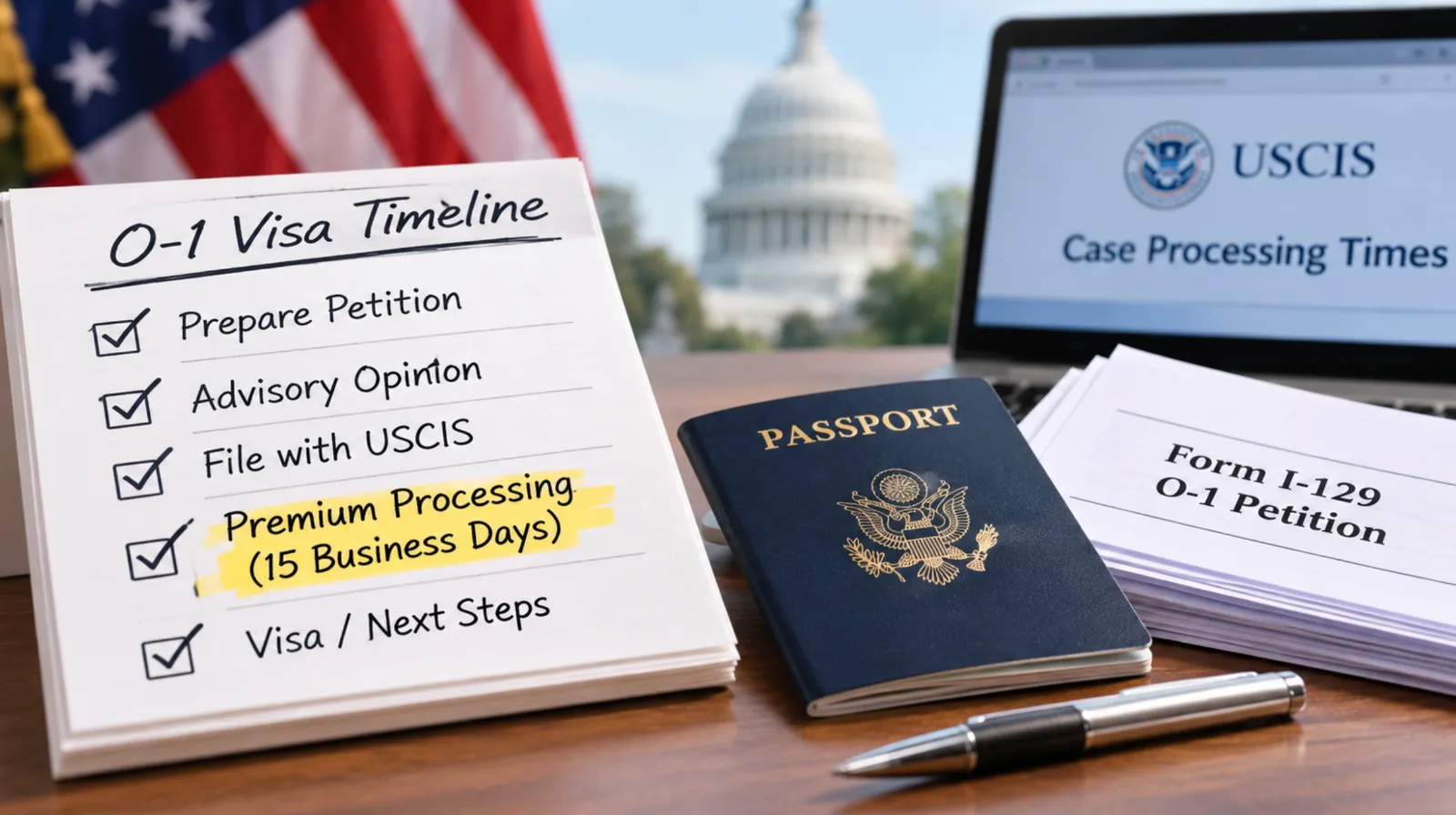
If you are planning an O-1 petition, one of the first questions is how long the O-1 visa processing time will take. There is no single timeline for every case. However, with premium processing, USCIS generally must take adjudicative action within 15 business days after receiving a properly filed premium-processing request.
That does not mean the entire O-1 process takes 15 business days. Timing also depends on petition preparation, USCIS's regular processing workload, whether USCIS issues a Request for Evidence (RFE), and whether the beneficiary must obtain a visa at a U.S. consulate.
This article explains the stages that drive the timeline, what you can control, and how to plan around the parts you cannot.
What "O-1 Processing Time" Actually Measures
People use the phrase to describe several different clocks. Separating them avoids unrealistic expectations.
- Preparation time: Gathering evidence, expert letters, the advisory opinion, and itinerary or contract documentation before filing.
- USCIS adjudication time: The period between USCIS receiving Form I-129 and taking action on the petition.
- Premium processing time: For O-1 petitions, USCIS generally must take adjudicative action within 15 business days, subject to the applicable rules.
- Consular time: For beneficiaries outside the United States, the time needed to obtain an O-1 visa after petition approval.
- Change-of-status or extension time: When the beneficiary is already in the U.S., approval of the petition may also include a change of status or extension of stay.
USCIS publishes current estimates on its Case Processing Times page. These estimates change and should be checked for the applicable Form I-129 classification and processing office.
For regular processing, USCIS does not guarantee a particular adjudication date. Premium processing offers a more predictable USCIS response period, but it does not eliminate preparation time or any subsequent consular procedures.
The O-1 Process, Step by Step
The O-1 is a nonimmigrant classification for individuals with extraordinary ability in the sciences, arts, education, business, or athletics, or extraordinary achievement in motion picture and television productions. O-1A and O-1B have different substantive eligibility standards.
The statutory basis is INA § 101(a)(15)(O), and the regulations appear at 8 C.F.R. § 214.2(o).
For a broader overview of eligibility, see our Extraordinary Ability Immigration Guide.
1. Evidence development
This is often the longest and most variable stage, and it is one of the stages most within your control.
An O-1A petition generally requires evidence of a major internationally recognized award or evidence satisfying at least three applicable regulatory criteria, followed by USCIS's evaluation of the totality of the evidence.
Collecting recommendation letters, media coverage, proof of judging, evidence of original contributions, compensation records, and other supporting documentation can take weeks or months.
The objective is not simply to accumulate documents. The petition should explain how the evidence satisfies the applicable legal standard and supports the beneficiary's proposed U.S. activities.
2. Consultation or advisory opinion
O-1 petitions generally require a written advisory opinion from an appropriate peer group, labor organization, management organization, or qualifying expert, depending on the classification and circumstances.
The regulations establish specific consultation requirements and exceptions. For example, where an appropriate peer group does not exist, the petitioner may need to provide evidence establishing that circumstance and comply with the applicable alternative procedures. The requirements also differ for certain arts and motion picture or television petitions.
The consultation requirement should not be treated as automatically waived simply because obtaining an opinion is inconvenient or an organization is slow to respond.
Requesting the appropriate consultation early matters because third parties may have their own processing procedures and turnaround times.
3. Agent or employer documentation
The petition must be filed by a qualifying U.S. employer or U.S. agent, rather than by the beneficiary acting solely on their own behalf.
Supporting documentation generally includes evidence of the employment or agency arrangement, such as a contract or summary of the terms of an oral agreement, and an itinerary where required.
Founders with their own companies should plan carefully for how this requirement is satisfied. A properly structured company may serve as petitioner in appropriate circumstances, but ownership of the company alone does not establish O-1 eligibility.
Coordinating corporate and immigration documentation early can prevent unnecessary filing delays.
4. Filing and USCIS adjudication
Once Form I-129 and supporting evidence are filed, USCIS issues a receipt notice and reviews the petition.
Under regular processing, timing depends on USCIS workload, case complexity, and other administrative factors.
Under premium processing, USCIS generally must take qualifying adjudicative action within 15 business days. That action is not necessarily an approval.
5. Decision, then visa or status steps
An approval notice (Form I-797) does not by itself admit someone to the United States.
Beneficiaries abroad generally must complete the appropriate consular visa process after petition approval, unless an exception applies. Appointment availability and possible administrative processing can extend the overall timeline.
Beneficiaries already in the United States may have different next steps if USCIS approves an eligible change-of-status or extension-of-stay request.
The Department of State publishes Global Visa Wait Times, which can assist with planning, although individual circumstances may affect the actual timeline.
Premium Processing for O-1 Petitions
USCIS offers premium processing for Form I-129 O-1 petitions through Form I-907.
Premium processing requires an additional filing fee and generally commits USCIS to take adjudicative action within 15 business days after receiving a properly filed request.
Two points are particularly important:
- Premium processing speeds up USCIS action, not necessarily the entire case. USCIS may approve the petition, deny it, issue an RFE, or take another qualifying action. If an RFE or Notice of Intent to Deny is issued, the premium-processing clock stops, and a new period begins after USCIS receives the response under the applicable rules.
- Premium processing does not improve the odds of approval. A petition must independently satisfy the legal requirements, regardless of the processing option selected.
The 15-business-day period should not be confused with 15 calendar days. Weekends and federal holidays can affect the expected response date.
Premium processing may be particularly useful when an employment start date, scheduled event, business engagement, or professional commitment creates time pressure.
Before filing, confirm the current fee and requirements through USCIS's official premium-processing guidance.
Factors That Lengthen the Timeline
Several recurring issues can add time, and many can be addressed through early planning.
- Incomplete or inconsistent evidence. Generic recommendation letters or insufficient documentation of achievements may lead USCIS to request clarification.
- Weak criteria mapping. Evidence should be organized against the applicable regulatory criteria, with a clear explanation of why it qualifies.
- Advisory opinion delays. Waiting until the petition is otherwise complete can postpone filing.
- Requests for Evidence. An RFE can substantially extend the overall timeline because additional documentation must be gathered and submitted before USCIS continues adjudication.
- Filing timing. An O-1 petition generally may not be filed more than one year before the beneficiary's services are needed. Working backward from the intended start date is important.
- Consular scheduling. Appointment availability and administrative processing vary by country and consular post and may add time after USCIS approval.
Even a well-prepared petition may receive an RFE. The objective is to reduce avoidable deficiencies, not to assume additional review can always be prevented.
Planning a Realistic Timeline
Rather than anchoring on a single published processing number, build a timeline in layers:
- Begin with the date you need to start work or attend an event, tour, or project.
- Account for any consular or change-of-status steps associated with approval.
- Review the current USCIS adjudication estimates and decide whether premium processing is appropriate.
- Allow sufficient time for the advisory opinion, petitioner documentation, and evidence preparation.
- Include a contingency period for a possible RFE or other unexpected delay.
For example, a beneficiary with an upcoming U.S. engagement may benefit from premium processing, but should still account for the time required to assemble a complete petition and, if abroad, obtain a visa.
If the proposed timeline puts the start date in jeopardy, it may be necessary to adjust the project date, consider premium processing, or evaluate another immigration pathway.
Our Immigration Pathway Selector can help compare potential options at a high level.
Founders and Entrepreneurs: Timing Considerations
Startup founders often ask whether the O-1 can be used for their own companies.
It can be possible, but the petitioner structure requires careful attention because the petition must be filed by a qualifying U.S. employer or agent, and the founder's extraordinary ability must be established through appropriate evidence.
Company formation, governance, contracts, and employment arrangements can affect how the petition is prepared.
A founder's business success may provide relevant evidence of extraordinary ability, but the petition must demonstrate that the beneficiary satisfies the applicable O-1 requirements.
Delays in forming the entity or documenting the proposed professional relationship can become a hidden source of lost time.
Thinking Beyond the O-1
The O-1 is a temporary nonimmigrant classification, but it is not subject to the same type of annual numerical cap as certain other employment-based nonimmigrant categories.
Qualifying O-1 employment may be extended under the applicable rules, although the permitted extension period depends on the circumstances.
Many O-1 holders eventually consider employment-based permanent residence.
Our comparison of the O-1 and EB-1A explains how the classifications differ in eligibility standards, duration, and long-term immigration objectives.
Evidence assembled for an O-1 petition may sometimes support a later EB-1A petition, but approval of one does not establish eligibility for the other.
Practical Checklist to Keep Your Case Moving
- Confirm whether O-1A or O-1B is the appropriate classification.
- Identify the qualifying employer or agent early.
- Determine the applicable consultation requirements and request the advisory opinion promptly.
- Prepare specific, factual recommendation letters tied to the relevant criteria.
- Organize evidence of awards, publications, judging, original contributions, compensation, and other qualifying achievements.
- Review current USCIS processing estimates and premium-processing requirements.
- Plan any consular steps and travel dates in parallel.
- Maintain a contingency plan for a possible RFE.
Frequently Asked Questions
How long does an O-1 visa take?
There is no fixed total timeline. With premium processing, USCIS generally must take adjudicative action within 15 business days, but petition preparation, RFEs, and consular procedures may add time. Regular USCIS processing varies.
Can I speed up my O-1 petition?
Yes, in part. Premium processing can accelerate USCIS action, while early preparation of evidence, consultation materials, and petitioner documentation can reduce pre-filing delays. Neither guarantees approval.
Does premium processing guarantee approval?
No. Premium processing establishes a timeframe for USCIS action, not a guaranteed favorable decision.
What happens if USCIS issues an RFE?
USCIS requests additional evidence concerning identified issues. The petitioner must respond within the deadline specified in the notice. If premium processing applies, the clock stops and a new period begins after USCIS receives the response under the applicable rules.
Do I need to be outside the U.S. to file?
Not necessarily. Beneficiaries already in the United States may be eligible for a change of status or extension of stay, depending on their circumstances. Those abroad generally complete consular visa processing after petition approval.
Is the O-1 timeline different for O-1A and O-1B?
The general petition process is similar, but the evidentiary and consultation requirements differ. Those differences can affect preparation time. USCIS adjudication estimates should be checked for the applicable classification.
Talk to ABIB About Your O-1 Timeline
Timing problems in O-1 cases can often be reduced when evidence, consultation requirements, and petitioner arrangements are planned together.
America's Business & Immigration Boutique (ABIB), based in Coral Gables, Florida, advises professionals, founders, executives, and companies on O-1 petitions and related business immigration matters.
Schedule a consultation to review your qualifications, develop a realistic filing timeline, and determine whether premium processing makes sense for your circumstances.
This article provides general information and does not constitute legal advice or establish an attorney-client relationship.
Sources
This article provides general information, not legal advice, and reading it does not create an attorney-client relationship with America's Business & Immigration Boutique. Laws and agency policies change; consult an attorney about your specific situation.
Related resources